
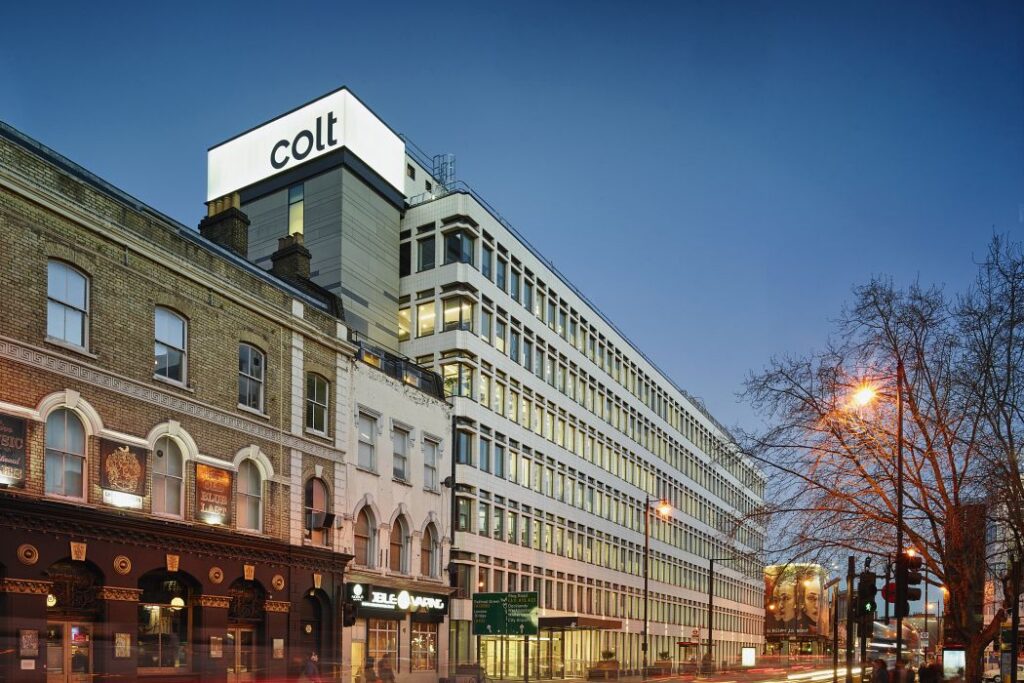
Colt House in London: when a smart building starts delivering measurable results
Buildings are often designed to guarantee good conditions even in the most demanding situations. That's how it should be, but in practice it often means that building services, ventilation in particular, run at unnecessarily high capacity even when actual occupancy, indoor air demand or thermal load wouldn't require it. This was the challenge we set out to solve at Colt Technology Services' Colt House in London, where Nuuka implemented a Smart Building solution on top of the existing building automation system. The goal was to reduce energy consumption without compromising indoor air quality or occupant comfort.
AI-driven optimisation
Nuuka’s solution is based on AI-driven optimisation that draws on measurements of indoor air quality, thermal conditions and the performance of the building services. The system optimises ventilation, heating and cooling typically every 1–5 minutes, delivering demand-based indoor conditions across all operating situations.
From Data to Impact: 35% Energy Savings at Colt House
At Colt House, the analysis focused on the electricity consumption of ventilation. Over the comparison period of 1 March – 30 June 2025, the calculated baseline consumption for ventilation was approximately 28.1 MWh, while the measured consumption during Nuuka’s optimisation was approximately 17.4 MWh. That translates into roughly 35% energy savings in the ventilation electricity consumption under review.
Scaled to an annual level, ventilation electricity consumption fell from approximately 85.4 MWh to approximately 52.7 MWh — an annual saving of around 32.7 MWh from ventilation electricity alone.
The climate impact was assessed as well. The net effect of the solution was calculated at approximately 8.7 tonnes of CO₂e emission reductions per year, accounting for the solution’s own energy use and the related first-order effects. The results were verified by a third party.
Smart Buildings That Act, Not Just Measure
The Colt House case is a good illustration of where smart buildings are heading. It’s no longer just about measuring, reporting or generating alarms. The real value comes from using the data produced by building services for continuous optimisation and operational decision-making.
What matters in particular is that the solution can be deployed on top of existing systems. There’s no need to replace the building automation system — it’s connected to AI and continuous optimisation instead, which means measurable results can be achieved quickly.
At Colt House, that meant concretely lower energy consumption, lower emissions and a better understanding of how the building actually performs.
The Future Is Already Built
For us at Nuuka, this is an important example of what Smart Building means at its best: making the existing building stock smarter, more energy efficient and more responsive to the real needs of the people using it.
Thank you to Colt Technology Services for the trust and the courage to put smart building solutions into practice. The results speak for themselves.
— Mikko Maja, CTO @ Nuuka
Want to read more about this case?
GeSI Member Spotlight: Colt Smart Building
EGDC Case study – Colt Smart Building
Colt Smart Building Calculator
____________________________